The Federal Government Almost Got There
This isn’t just a Colorado problem. Historically, the U.S. Census Bureau has classified people with roots in the Middle East and North Africa as white. The bureau proposed adding a Middle Eastern and North African category for the 2020 census but ultimately did not move forward. In March 2024, the Office of Management and Budget formally updated federal standards to include a dedicated Middle Eastern or North African category, a significant shift in how our communities are recognized in federal data collection. This is a meaningful step, but implementation is still ahead of us, and Colorado shouldn’t have to wait for Washington to catch up.
Making Sure Every Coloradan Counts
At CHI, making sure every community is seen in the data isn’t a side project. It’s the work. We value accessibility, integrity, and building systems that put people first. Uncovering people hidden in the data is one way we live those values.
How have we done that work? Two years ago, CHI partnered with the Colorado Asian American and Pacific Islander (AAPI) Circle on the Colorado Lotus Project, examining the health and well-being of Colorado’s Asian American, Native Hawaiian, and Pacific Islander communities. The project revealed the distinct experiences within a group too-often treated as one. This work now lives on in partnership with our friends at Colorado Asian Culture and Education Network (CACEN).
The Middle Eastern and North African findings from the CHAS are in that same vein; every Coloradan deserves to be counted.
What Happens When You Finally Look
In 2021, CHI added Middle Eastern and North African as a distinct category on the Colorado Health Access Survey. (A quick note about terminology: The Colorado Health Access Survey uses Middle Eastern and North African as its official category. Many members of my community prefer Southwest Asian and North African, because it centers our own geography and identity rather than using terms defined by others.)
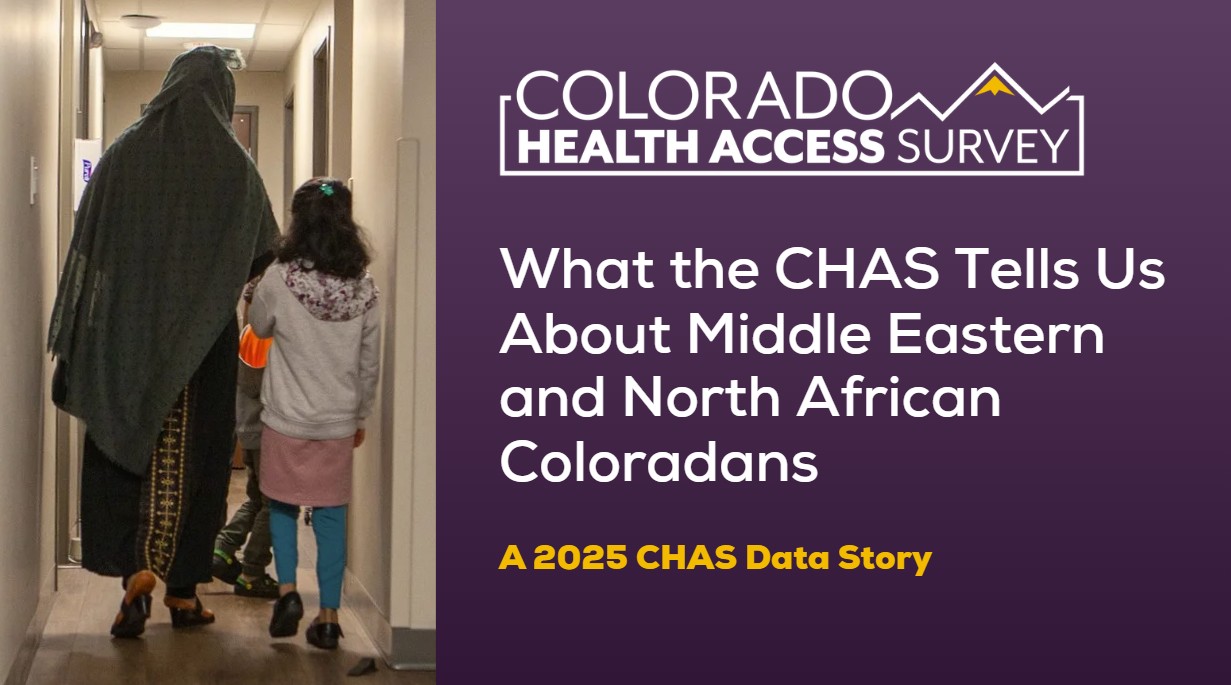
Our new analysis required combining data from the 2021, 2023, and 2025 surveys to get a large enough sample to report anything meaningful. Less than 1% of Coloradans identified as middle Eastern and North African. It took years of intentional data collection just to say anything at all.
But when you finally look, what you find is striking.
In 2025, more than half of Middle Eastern and North African Coloradans were between 19 and 29, four times the state average. Two in three had a college or postgraduate degree. Nearly half were born outside the U.S. Almost two thirds spoke a language other than English at home. The population more than doubled between 2021 and 2025, from an estimated 15,000 to 40,000 Coloradans.
This is a growing, young, and highly educated community.
And one finding carries particular urgency. Nearly half (47.7%) of Middle Eastern and North African Coloradans were covered through Medicaid. Beginning in October 2026, refugees, asylees, humanitarian parolees, and other immigrant groups will no longer be eligible for Medicaid coverage. Without tracking data for this community, we can’t even begin to understand how many Middle Eastern and North African Coloradans will be affected or how to respond. You can't serve a community you can’t see.
What We Still Don't Know — And Why It Matters
These findings are a starting point for sparking curiosity into more research. The sample is still small. We can’t yet break the data down by country of origin or other deeper cuts. An Iraqi American’s health experience may look very different from an Iranian American's or an Egyptian American’s.
The fabric of the Middle Eastern and North African community is not monolithic. The CHAS asks Middle Eastern and North African respondents their country or region of origin. Look at the range of countries (nearly two dozen) in the CHAS alone: Algeria to Iraq, Egypt to Oman.
And even that list is incomplete. Identities like Kurdish, Druze, Amazigh, Turkmen, Baluchi, Assyrian, and Chaldean remain invisible in data. Just like I once didn’t have a box to check, many still don’t. Recognition can’t stop at the category level; it has to reach the people within it.
But in some ways, it already has started to. The kid who used to check the wrong box now works at an organization that finally created the right one. My community exists in the data now, imperfectly, incompletely, but visibly. And visibility is where everything starts.
My favorite Arab American writer Khalil Gibran once said, “Say not, ‘I have found the truth,’ but rather, ‘I have found a truth.’” That’s where we are.
Our team has started to uncover some “truths” about Colorado's Middle Eastern and North African community. There are many more to find. And we will keep asking.