Image
Banner image for the 2025CHAS
Topics

Colorado Health Access Survey 2025

The 2025 Colorado Health Access Survey captures Colorado in between two landmark events — the COVID-19 pandemic and the upcoming federal cuts to health and social programs. 

November 26, 2025

Since 2009, the CHAS has documented the effects of health policy changes — the Affordable Care Act in the 2015 survey, the response to the COVID-19 pandemic in 2021, and the end of pandemic support starting in 2023. 

Policy changes quickly. Year after year, the CHAS has provided data on the real-world effects of those changes on health care access and the affordability of basic needs such as food, housing, and health care. The survey also has shown that uninsured people face much greater problems affording health care and often skip care entirely.

The 2025 survey arrives on the cusp of another wave of policy changes. This report shares the headlines of our initial analysis, with additional details in the graphics on the following pages. But there are many more stories to uncover. Let us know what stories you find in the data or how these trends are playing out in your community. Email us at chas@coloradohealthinstitute.org.


Image
CHAS logo computer screen icon

How Does the CHAS Benefit Your Work?

We want to know how Colorado Health Access Survey data impacts your work in Colorado’s health care ecosystem. Your feedback could help inform future areas of exploration. Click to complete a brief survey

SEVEN STORIES FROM THE 2025 CHAS

Colorado’s insurance landscape is holding steady.

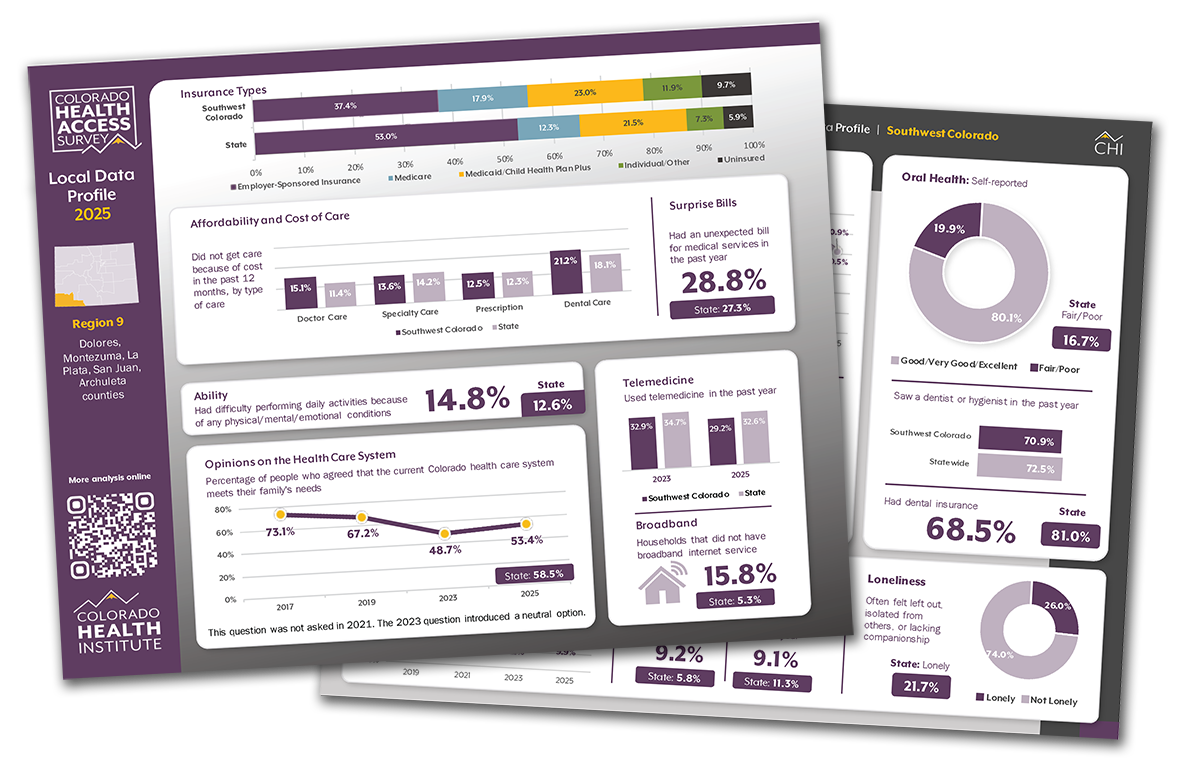
The uninsured rate is 5.9%, which is statistically similar to every survey since 2015, after the Affordable Care Act took effect. Medicaid enrollment has also returned to its pre-pandemic level, with about a fifth of Coloradans in the program. And more than half of Coloradans got their health insurance through an employer for the first time since 2019.


Health insurance does not always make health care affordable.

People with insurance saw the doctor more often than people without insurance, but many of them still couldn’t afford the care they needed. The 6.7% of Coloradans who purchased coverage on the individual market had more problems affording health care than any other group except the uninsured.


People with public health insurance are happier with the health care system.

Two-thirds of Medicaid and Medicare members had positive views of the health care system. People with employer-based insurance were less happy, and only about half of those on the individual market had a positive view of the system. But people without insurance were the least positive, with only 20% saying the health care system works for their family.


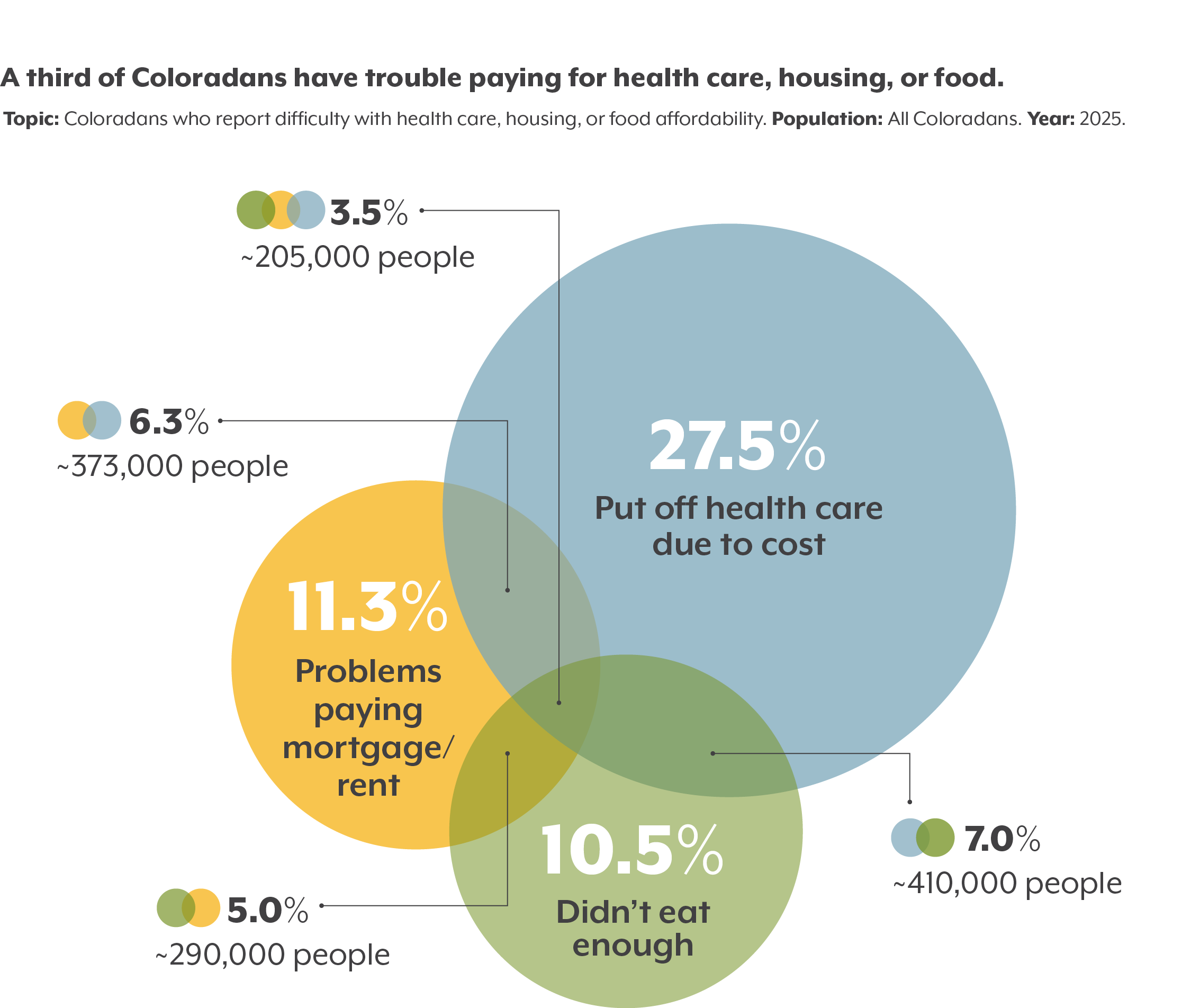
One third of Coloradans struggle to afford health care, food, or housing.

Many Coloradans face hard choices about paying for essentials. More than a quarter skipped health care because they couldn’t afford it, more than a tenth couldn’t afford food, and another tenth had trouble paying their rent or mortgage.

Image
Venn diagram showing 27.5% of Coloradans put off health care due to cost, 11.3% had trouble paying for housing, and 10.5% didn't eat enough because food was expensive. 3.5% of Coloradans experienced all three issues.

Fewer Coloradans say their mental health is poor.

This is a notable improvement that breaks a trend of worsening mental health results over the past decade of surveys. Children under 18 are getting better access to behavioral health care. But young adults ages 18 to 29 show the highest rates of poor mental health and the least access to needed care. 


One in five Coloradans is lonely.

New questions on the survey reveal the scope of social isolation and its strong tie to health. People who reported loneliness were more than twice as likely as other Coloradans to say their overall health is poor or only fair.


The survey reveals health and social disparities for people with diverse gender identities, young adults, and Native Americans, among others.

People in these groups reported much higher levels of poor mental health or economic stress. More than four in 10 American Indian or Alaska Native Coloradans had trouble paying for health care, housing, or food. Young adults reported more challenges than all other age groups with mental health, social isolation, and paying for health care, food, and housing. And two-thirds of people who identified as a gender other than male or female said they were lonely.

The most important story is yet to be written. 

The 2025 CHAS arrives at a pivotal moment — between the pandemic and the expected cuts to health and social benefits driven by tight state budgets and federal policy changes. Future versions of the Colorado Health Access Survey will measure the experience of Coloradans against the baseline established by the 2025 survey.


Making the CHAS Possible 

The Colorado Health Access Survey is made possible by financial supporters who understand the value of this public resource. While the Colorado Health Institute stewards the survey and makes the data and analysis available, the CHAS would not exist without the foundations, government agencies, and other funders that are committed to datadriven decision-making. These sponsors ensured that CHI could collect, analyze, and release these important data. 

But there’s more to do. We are continuing to work with funders to sponsor topic-specific analyses, community presentations and education sessions, and other activities. If you are interested in joining this community of supporters, please contact Suman Mathur at mathurs@coloradohealthinstitute.org.

2025 Sponsors

Image
2025 CHAS Sponsors logos